Overview
Consequently, demand forecasting is no longer a matter of speculation since the AI-ML models entered the industry. At Galific Solutions, our innovative team creates custom machine learning solutions to analyze an organization’s performance, based on historical sales, market trends, seasonality, and behavioral patterns, to accurately predict future demand. Thus, market unpredictability would also be reduced.
Additionally, our forecasts help you plan inventory, staff, production, marketing, and procurement, enabling you to avoid stockouts, overordering, and wasted expenditures.
What We Deliver
- Prediction on market demand at the SKU, powered by AI.
- Time series, regression, and hybrid models
- Enabling adjustments in the ever-changing market trends.
- Dashboards that allow you to plan and take appropriate action.
- Supply Chain System Integration
Services available with our AI in Demand Forecasting
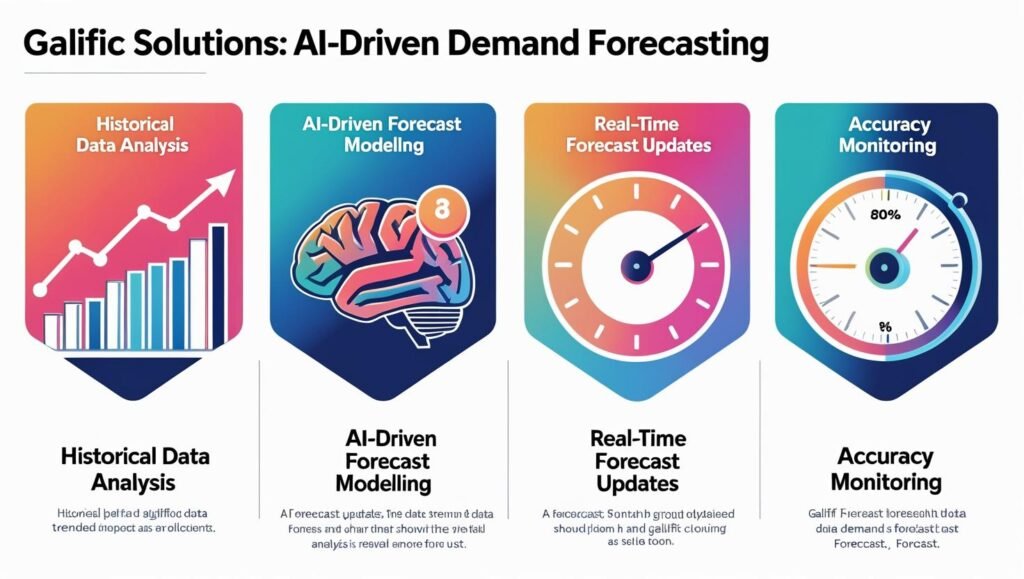
Galific Solutions provides the following AI-driven services in Demand Forecasting.
1. Demand Forecasting – Historical data analysis
- Firstly, the AI-powered demand forecasting cleans and structures past sales data.
- Next, it identifies the latest marketing and sales trends and detects anomalies
2. Demand Forecasting – AI-Driven Forecast Modeling
- Train custom machine learning models on domain-specific data sets
- Promotes long-term and short-term demand forecasting at the SKU level.
3. Demand Forecasting – Real-time forecast updates
- Never-ending learning process from new data inputs
- Makes a dynamic adjustment to reflect demand shifts.
4. Demand Forecasting – Accuracy Monitoring
- Forecasts and tracks performance, providing tuning suggestions as guidelines.
- Enhances the model’s accuracy in every cycle.
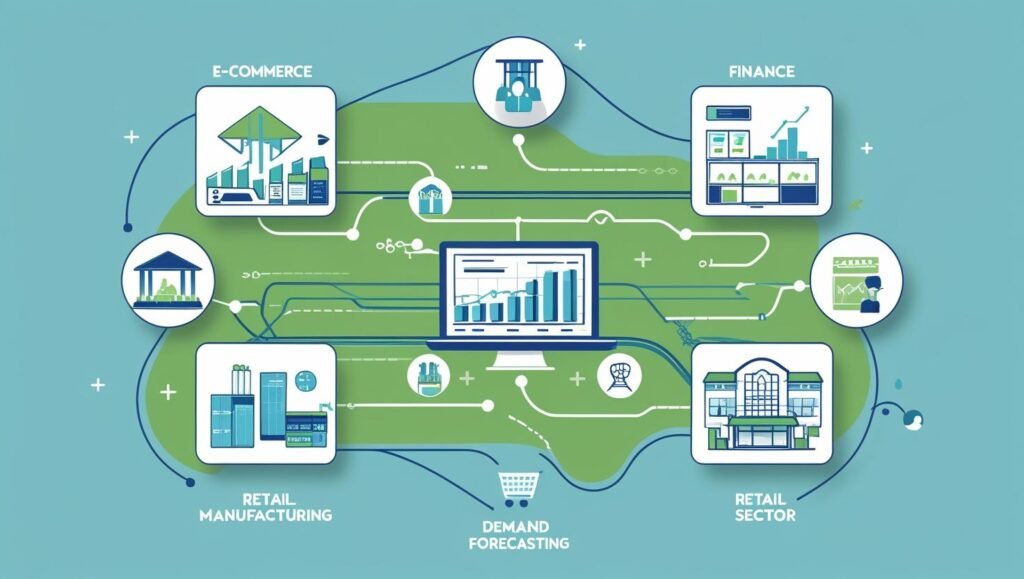
Industries We Support
E-Commerce:
In a fast-paced e-commerce world, customer needs and demands change rapidly in a cut-throat competition. Therefore, there would be challenges such as rapid changes in customer needs, flash sales, and high SKU volume. Hence, accurate demand forecasting becomes the primary aspect for operational efficiency.
How we help
- Predict the trending products for upcoming seasons or events.
- Optimization of inventory placement across warehouses to save time on delivery.
- Encourages dynamic pricing and promotion according to real-time demand signals.
- Reduction of cart abandonment with timely stock purchases.
Finance:
Consequently, in the financial sector, banks and financial companies face challenges such as volatility in loan product demand and seasonal fluctuations in investment behavior.
How we help
- In particular, our AI forecasts or predicts demand for credit products, including personal loans, business loans, and other types.
- Consequently, AI helps in anagement of liquidity and capital allocation based on the demand forecast of customer inflow predictions.
- As a result, the tools promote an efficient staffing model designed for customer support and underwriting.
- Allows cross sell and upsell campaigns.
Manufacturing:
Consequently, the manufacturing industry faces challenges such as long production cycles, rigid supply chains, and fluctuating orders.
How we help:
- Forecasts the demand for part and raw materials to ensure a streamlined procurement.
- Preventing delay in productions through anticipation of spikes and dips of customer’s orders.
- Aligns factory output to real-time consumption based on market trends.
- Minimises the wastage of dead stocks via lean production plannig.
Healthcare:
Consequently, the healthcare industry faces challenges such as seasonal demand fluctuations, unpredictable patient volumes, and a shortage of critical resources. Hence, you need an AI demand forecasting tool that prepares and analyzes the patient’s ever-changing needs and monitors your inventory. Therefore, you would neither have a shortage of stocks nor overstocking.
- Predicts the demand for medicine and equipment in hospitals, pharmacies, or distributors.
- Enables staffing optimization during periods of high patient inflow.
- Supports health insurance companies in forecasting claims volume to manage reserves.
- Supports PPEs, proactive inventory, diagnostic kits, and other consumables.
Retail:
In the retail industry, margins are usually tight and depend on timing. Furthermore, these industries face challenges including high product turnover, promotional dependencies, and regional demand shifts. Therefore, you need an AI-ML model for demand forecasting, so you would be equipped to counter these difficulties.
How we help
- Forecast on demand per store and SKU that enable a better shelf planning.
- Enables you to avoid overstocking or a deficit of seasonal items.
- Provides support for omnichannel (online and offline) synchronization.
Frequently Asked Questions
Q1. How is AI responsible for the improvement of demand forecasting?
Unlike traditional tools, AI can adapt to new data and ever-changing conditions in real-time. Moreover, it learns, extracts, and derives historical data from past patterns, real-time signals, and external data sources such as holidays or weather. Eventually, the AI tools would make continuous, accurate predictions.
Q2. What is the information required to start demand forecasting?
Firstly, you need vital information such as sales history and SKU/product data. After that, it may become critical to consider promotional calendars to take into account supply constraints. Additionally, the need to factor in external elements such as market demand or footfall data becomes necessary to make a detailed forecast.
Q3. Will AI-ML models work for businesses with seasonal demand?
Firstly, our models are trained and designed to detect and adjust for seasonal peaks, regional preferences, and event-driven fluctuations. Hence, you can be assured about the deliverability for businesses with seasonal demand.
Q4. How can I use these forecasts?
Once your forecast is ready, you can synchronize it with your inventory system, dashboards, or use it to design marketing strategies. Moreover, the alerts, reports, and recommendations act as the guidelines for you to take the right actions at the right time.
Q5. What is the accuracy level of your forecasts on average?
Initially, our AI-ML models deliver demand forecasting of 85–95% accuracy on valid and relevant data. Later on, the accuracy level of your forecasts would improve as you feed more data.
Q6. How often should we update the forecasts?
To begin with, the forecasts can run daily, weekly, or monthly, depending on the environment. At this stage, you can view and implement these recommendations to update the estimates.
- Daily/Weekly update – High-frequency data or volatile environments like retail, weather, or financial markets like banks or stock exchanges.
- Monthly or Quarterly update – For a stable environment, such as planning in the manufacturing industry, and annual budgeting.
- Yearly or Bi-Yearly update – Best suited for strategic long-term planning.
By Use Case
- Sales Forecast – Recommended weekly or monthly.
- Stock or Supply Chain Forecasts – Daily or weekly
- Financial Forecasts – Monthly or Quarterly, depending on the market situation.
- Demand forecasting in the case of retail or FMCG – Daily to weekly
- Time Series Models – On the arrival of new data, which comes weekly.
- Workforce Planning – Quarterly.
When are frequent updates recommended?
- Sudden market shifts can occur due to unavoidable circumstances, such as economic slowdowns, downturns, or pandemic situations like COVID-19.
- Unexpected events like weather or disruption in the supply chain.
- Deployment of a new product or introduction of a new service.
- Changes in data drift or model, or a decline in market performance.