Manual workflows, whether in data entry, document processing, customer support, or logistics, constitute hidden drains on productivity, costs, and employee morale. Gartner forecasts that 69% of routine work currently performed by managers will be fully automated by 2024, indicating a massive shift away from manual tasks. Meanwhile, research from McKinsey estimates that in many organizations 30% or more of work activities could be automated using today’s technologies, and up to 45% of employee time is potentially automatable. These inefficiencies translate into wasted labor hours, slower throughput, and increased error rates, problems AI automation is uniquely poised to address
The Hidden Costs of Manual Workflows
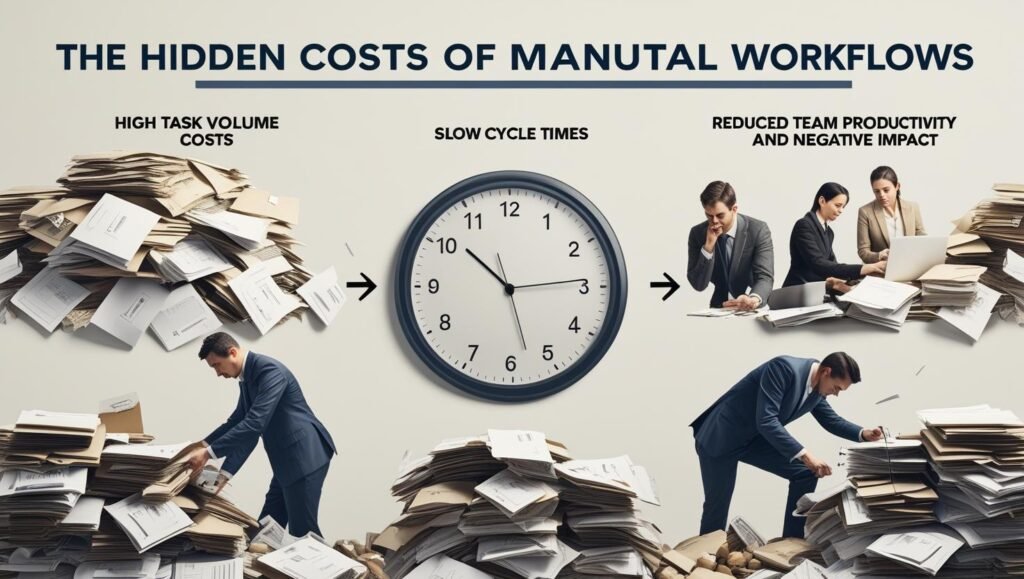
Task Volume and Cost
- On average, 69% of tasks across organizations are automatable. Manual data entry alone contributes to error rates exceeding 80%, causing rework and delays.
Slow Cycle Times
- Manual workflows extend cycle times by 40–80%, slowing deliverables across departments.
- In customer onboarding or order support, response times can be up to 50% longer compared with automated workflows.
- Organizations still relying on manual workflows often face cost overruns of 20–30% in operational budgets.
Productivity and Impact on Teams
- Workflow inefficiencies reduce employee productivity by up to 63% in process-heavy departments
- Key performance metrics, like report generation, approvals, and onboarding, are often bottlenecked by manual handoffs, task duplication, and lack of visibility.
All told, manual workflows create a slow, error-prone, and expensive environment that hampers growth. Now, AI offers scalable fixes.
How AI Automates and Optimizes Workflow?
AI eliminates manual workflows and optimizes your workflow by:
Automating the Routine
- AI-driven automation can handle routine tasks such as data entry, document processing, and email sorting.
- It reduces manual data entry time by up to 50%, lowers inventory holding costs by 25%, and boosts task completion rates by 30%.
Predictive Maintenance & Process Uptime
- In industries with equipment or heavy machinery, AI predictive maintenance can cut downtime by 30–50%.
- Reduced unplanned downtime and improved equipment utilization contribute directly to operational efficiency.
Workflow Speed & Error Reduction
- Automated customer service solutions like AI chatbots slash response times by 40–50% and resolve routine issues without human intervention.
- Process cycle time reduction of up to 60% is observed when workflow tasks are automated end-to-end.
Decision-making and Intelligence
- AI systems process data thousands of times faster than humans, enabling more agile decision-making and fewer delays in high-stakes situations.
- In manufacturing and logistics, AI-based supply‑chain forecasting improves accuracy by 50%, reducing planning errors and stockouts.
Impact by Industry & Domain
Manufacturing & Industrial
- 85% of manufacturing companies using AI report improved operational efficiency, with 78% noting production cost reductions.
- AI-powered automation reduces manual labor by 40–60%, cuts scrap rates by 20–25%, and improves product quality via visual inspection accuracy rates exceeding 97%.
Professional Services & Finance
- Consulting firms like Grant Thornton and EY are enabling staff to save up to 7.5 hours per week through AI. They’ve automated up to 40% of tasks, boosting overall efficiency by 20% in administrative workflows.
- Bank giants such as JPMorgan Chase report ~30% lower servicing costs and over 3× productivity in advisory and client servicing tasks using AI tools.
IT & Development Workflows
- According to Atlassian, 68% of developers report saving over 10 hours per week courtesy of generative AI, up from 46% the previous year.
- Fragmented manual workflows cost developers millions in lost productivity due to slow collaboration and slow access to information.
Supply Chain & Logistics
- Last‑mile delivery comprises roughly 41% of total logistics costs, often burdened by manual route planning and delays.
- Companies using AI for route optimization, predictive maintenance, and demand forecasting see significant improvements in efficiency and lower customer service calls.
Legal & Document Processing
- AI legal platforms like Luminance automate tasks like contract review and negotiation once delegated to junior lawyers, shortening turnaround while reducing error. Their query volume is up 40-fold, with revenue growing five times.
Step-by-Step AI Implementation to Fix Manual Bottlenecks
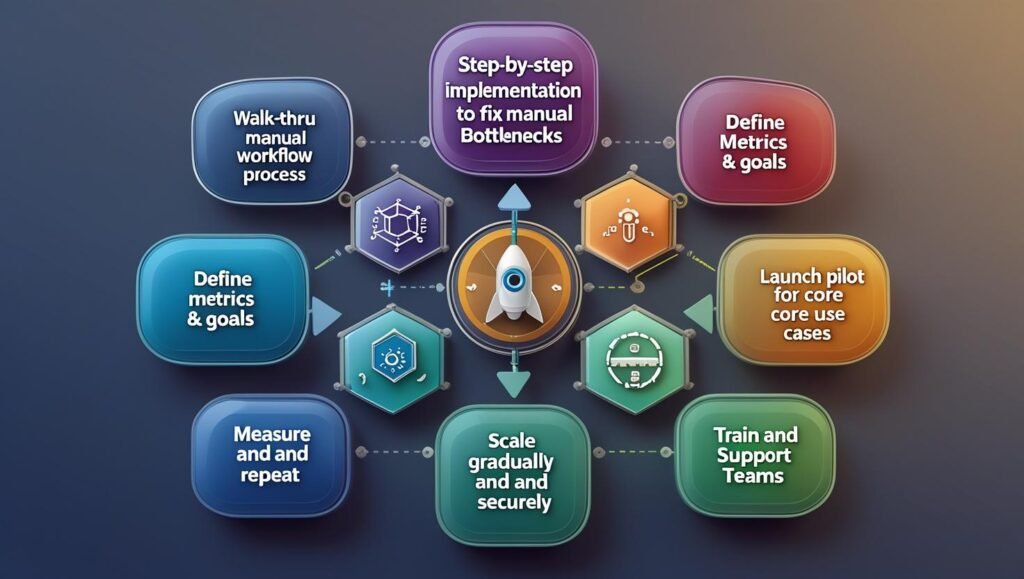
Step 1: Walk-thru Manual Workflow Process
Inventory all manual processes: data entry, approvals, repetitive mailing, file routing, among others. Prioritize according to volume and error rates, followed by strategic impact.
Step 2: Define Metrics & Goals
Set achievable goals, such as reducing manual processing time by 50% or reducing onboarding cycles by 60%. Benchmark success through baselining of data.
Step 3: Tool Selection
Evaluate AI and RPA solutions fitting your workflow technology stack. Platforms with capabilities of predictive analytics, chatbot automation, or generative AI can automate tasks that are high-volume and low-value.
Step 4: Launch Pilot for Core Use Cases
Start by utilizing workflows, such as invoice approvals or ticket triage, to measure the time saved, decrease in errors, and employee satisfaction.
Step 5: Measure and Repeat
Monitor KPIs including cycle time, error rate, employee hours saved, and cost savings; use the data collected to improve automation logic, and expand its invocation into the departments.
Step 6: Scale Gradually and Securely
The successful pilots must be implemented and run organization-wide. In some cases, this may require human oversight. Data governance must be implemented to ensure data privacy and quality.
Step 7: Train and Support Teams
Conduct training and change management activities to facilitate the adoption of AI tools by the workforce. Position AI as a colleague, not a competitor, by clearly stating its advantages.
Pitfalls to Avoid in AI Adoption
- Overpromising without realism: Some companies claim 70–80% productivity gains in mere years. Experts caution that such expectations are often unrealistic.
- Replacing humans entirely: Agencies warn that removing human roles outright, especially in customer-facing or creative domains, can erode trust and flexibility.
- Neglecting data quality: AI is only as good as the data it learns from. Ensure clean, well-structured inputs to avoid compounding inefficiencies.
- Poor change management: Failure to train and onboard teams leads to resistance. AI succeeds when it’s seen as a tool that augments, not replaces.
- Ignoring security and compliance: Automated workflows often touch sensitive data. Governance frameworks are essential.
Long-term Benefits and ROI
- Cost Savings and High ROI: AI-driven automation consistently reduces operational costs by 20% to 30%. Many organizations report a return on investment (ROI) within the first year, with some projects achieving ROI levels of 100% to 300%, thanks to efficiency gains and reduced manual effort.
- Boost in Productivity and Speed: Businesses adopting AI automation often see a 20% to 40% increase in productivity. Tasks are completed faster, human errors are significantly reduced, and process throughput improves across departments, including finance, HR, customer service, and logistics.
- Enhanced Employee Experience and Satisfaction: By automating repetitive and time-consuming tasks, employees can save up to 20 hours per week. This not only reduces burnout and manual fatigue but also enables staff to focus on more meaningful and strategic work, leading to higher job satisfaction and retention.
- Smarter, Faster Decision-Making: AI-powered tools equipped with real-time analytics and intelligent dashboards help leadership teams make data-driven decisions more confidently and up to five times faster. This leads to quicker responses to market changes, operational bottlenecks, and customer needs.
- Stronger Competitive Advantage: Organizations embracing automation gain agility across their operations. They can onboard employees faster, respond to supply chain changes in real-time, and deliver more personalized customer experiences, helping them stay ahead of competitors and drive sustainable growth.
- Scalability and Business Continuity: AI systems can easily scale to handle increased workloads without incurring proportional increases in cost or staffing requirements. This ensures business continuity during peak periods, helps manage risk better, and supports long-term strategic growth initiatives.
Conclusion
So fundamentally, mezzanine workflows rob money through delays, errors, cost overruns, and employee disengagement. The data today offers an alternative: automation through AI creates a systematic approach to produce measurable results.
AI resolves the inefficiencies left behind by manual workflows by performing repetitive tasks, reducing downtime, expediting decisions, and enabling the workforce to focus on high-value work. With a potential productivity increase of 20–40 percent, labor cost reductions, and a fast ROI, AI is imperative.
Now, if you want to change how work gets done, work your way through the most manual processes, get some clear metrics, choose your applications, and take your teams along. If done correctly, the application of AI does much more than fix workflows; it unlocks new levels of performance.